
Tree Trimming vs Tree Removal in Grand Rapids, MI
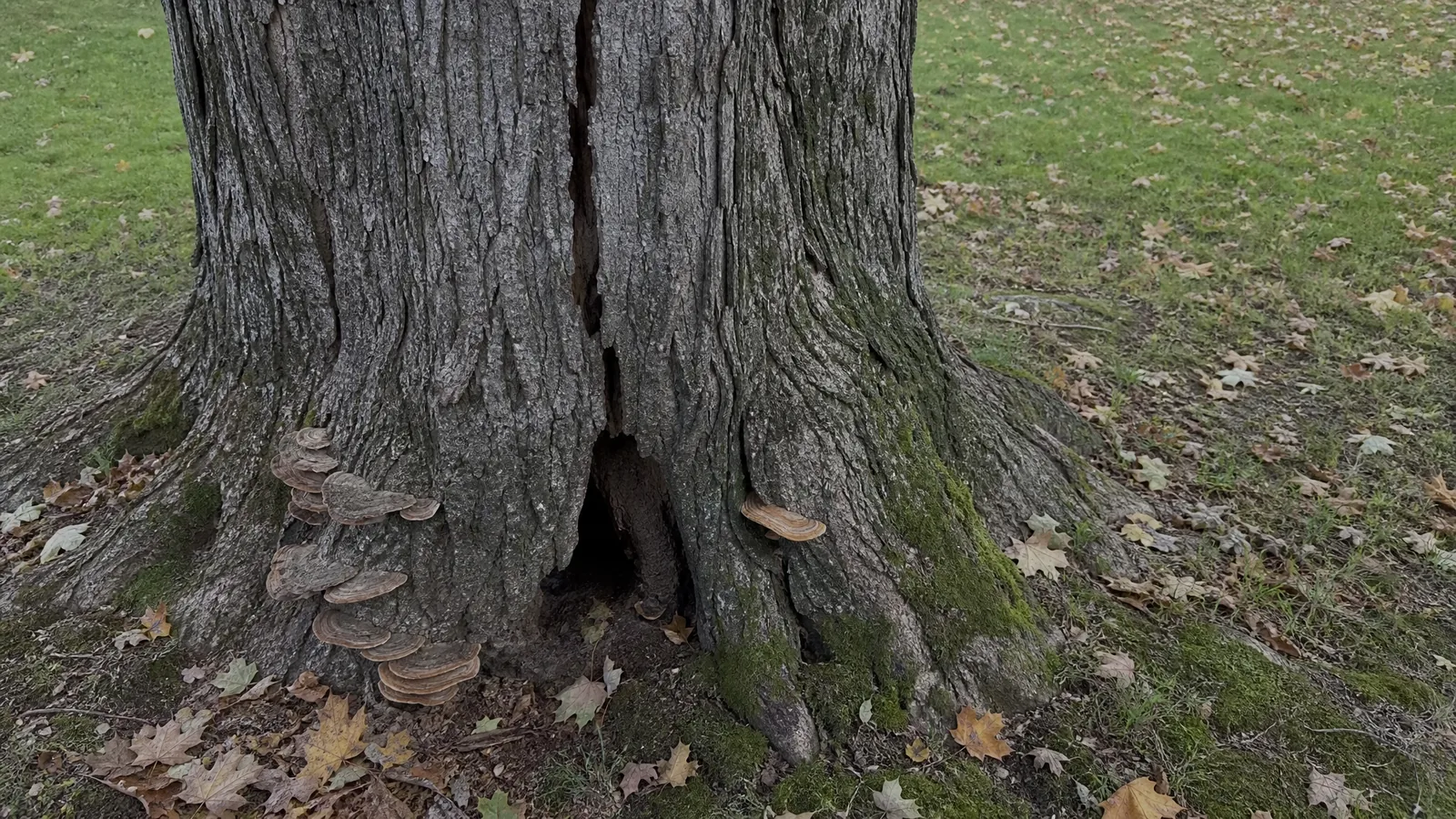
The test is simple and it is not about how the tree looks. Branch defects are usually prunable and trunk and root defects usually are not. A tree with dead limbs, a limb over the roof or one sided growth is a trimming job. A tree with a large trunk cavity, a vertical crack, fungal conks at the base or a root plate that has moved is a removal conversation, and no amount of pruning changes that.
Ask us about your own tree
A person calls you back the same day, or first thing the next morning if you reach us after six. Storm calls get picked up whenever they come in.
Defects that mean trim
Deadwood anywhere in the crown. Dead branches are the cheapest thing to deal with and their removal costs the tree nothing, because it has already written them off.
Rubbing or crossing limbs, which wear through bark and create wounds.
Clearance conflicts: limbs on the roof, over the driveway, into the neighbour's airspace, against the gutters.
One-sided or over-extended growth after a neighbour built, felled or fenced. Reduction on the heavy side rebalances it.
Co-dominant stems with a sound union. That is a cabling and reduction job, $400 to $2,000, and the tree can carry on for decades.
Storm-torn limbs, cleaned back to a proper cut rather than left as a ragged stub.
Defects that usually mean remove
A trunk cavity larger than about a third of the stem diameter at that height. Trees are hollow cylinders and cylinders are strong, but past roughly a third of the wall gone the arithmetic stops working.
A vertical crack running any real distance up or down the trunk, particularly one you can get a finger into.
Fungal fruiting bodies at the base or on buttress roots. Conks at the root collar mean decay in the part of the tree holding it upright, and by the time they are visible the decay is established.
A root plate that has moved, which you read from cracked turf or heaved soil ten or twelve feet out from the trunk. Roots do not reattach.
Dead ash, no exceptions worth arguing about. It gets more expensive and more dangerous every season.
Included bark at a co-dominant union that has already started to split. Before it splits it is cabling. After, it is not.
The third category nobody quotes for
Roughly a third of the trees we are called to on a removal enquiry need neither trimming nor removal. They need something else entirely, and it is almost always at the bottom of the trunk.
Girdling roots wrapping the stem and slowly strangling it. A root flare buried under six inches of fill or a mulch volcano piled against the bark, trapping moisture and inviting decay. Compaction from a build or from vehicles parked on the root zone. All three present as a thinning crown, which everybody reads as a disease or a pest, and all three are fixed by a root collar excavation at $250 to $600 rather than by a chainsaw.
This is why the estimate visit is free and why we walk the base of the tree before looking up.
The honest economics
Trimming a tree you should have removed is money spent twice, because you pay for the prune and then for the removal anyway, usually inside three years and sometimes after the tree has cost you a roof in between.
Removing a tree you should have trimmed is worse in a different way. You have paid more, you have lost forty years of growth you cannot buy back, and on most Grand Rapids lots you have also lost the summer shade that keeps the house liveable in August. Mature trees are also assessed as adding real value to a property, which is a thing that only shows up when you sell.
Which is why the decision is worth $175 to $450 of somebody's honest opinion in writing before you spend $2,000 acting on a guess.
| What you can see | Where the defect is | Usual answer | Typical cost |
|---|---|---|---|
| Dead branches in the crown | Branches | Trim | $250 to $550 |
| Limb on the roof or over the drive | Branches | Trim | $300 to $750 |
| Two equal stems, tight V, dark seam | Union, not yet split | Trim and cable | $400 to $2,000 |
| Same union, already split | Union, failed | Remove | $1,000 to $2,500 |
| Cavity over a third of the trunk | Trunk | Remove | $1,000 to $4,000 |
| Conks at the base or on buttress roots | Root collar | Remove | $1,000 to $4,000 |
| Cracked turf, heaved soil at root plate | Roots | Remove, promptly | $1,000 to $4,000 |
| Thinning crown, no other symptom | Usually the root collar | Neither, excavate first | $250 to $600 |
| Ash, thinning from the top, sprouts low | Whole tree | Treat or remove, depends on crown | $8 to $15 per in, or $1,000 to $2,500 |
One caveat that overrides the whole table: what is underneath the tree changes the answer. A hollow trunk over open lawn is a low-risk tree. The same trunk over a bedroom is not, and the tree has not changed.
Get the number for your actual tree
Everything above is a range. A written quote after somebody has walked it is not.
Free written estimate Insured, COI on request We haul it or we leave the chips
Questions people actually ask
- How much of a tree can be safely pruned at once?
As a working rule, no more than about a quarter of the live crown in a single season on a healthy mature tree, and less than that on an old or stressed one. Leaves are how a tree earns its living, so removing too much at once forces it to spend stored reserves it may not have. If a job requires more than that, it should be staged over two or three seasons, and anyone proposing to take half a crown in one go is describing topping.
- Is a hollow tree always dangerous?
No, and this is the most common misconception in tree work. Trees are engineered as hollow cylinders and a cylinder retains most of its strength until a surprising amount of the wall is gone, which is why so many hollow veterans stand for decades. The threshold is roughly a third of the stem diameter, and the real question is what the tree would hit. A hollow trunk over a lawn and a hollow trunk over a child's bedroom are the same tree and completely different decisions.
- My tree is thinning at the top. What is it?
Most often something at the bottom. Crown thinning from the top down is the classic symptom of root and root collar trouble: girdling roots, a buried root flare, soil compaction, or grade change from a build. It is also the symptom of emerald ash borer if the tree is an ash. Before treating anything, have somebody excavate the root collar and look, because that is a $250 to $600 answer to a question people routinely spend thousands guessing at.
Ask for a written price
A person calls you back the same day, or first thing the next morning if you reach us after six. Storm calls get picked up whenever they come in.
Prefer to talk? Ring (616) 297-2972. Photographs help more than descriptions, and one that shows the gate or the side of the house is worth three of the tree.