
Tree Disease & Insect Treatment in Grand Rapids, MI
Treating an ash against emerald ash borer costs roughly $8 to $15 per inch of trunk diameter every two years, against $1,000 to $2,500 to remove the same tree once it dies. That is the whole economic argument and it only works while the tree still has most of its canopy. This page covers the two problems that actually kill trees in Kent County, oak wilt and emerald ash borer, plus the handful of others worth knowing about here.
Ask about tree disease treatment in Grand Rapids
A person calls you back the same day, or first thing the next morning if you reach us after six. Storm calls get picked up whenever they come in.
Oak wilt, and the two calendars
Oak wilt is a fungal disease spread two ways: overland by sap-feeding beetles that carry spores into fresh wounds, and underground through root grafts between neighbouring oaks. Red oaks can die within weeks. White oaks decline more slowly and often survive. The tell is a red oak dropping green or half-browned leaves in mid-summer, from the top down and from the outside in.
The prevention is entirely about timing, and Grand Rapids has two official answers. The Michigan DNR high-risk window is April 15 to July 15. The City of Grand Rapids Forestry Division asks residents to avoid trimming oaks from April through September and its current notice says wait until late October. We work to the city window. If an oak is wounded inside it by accident, storm or a builder, paint the wound with latex or tree-wound paint the same day, which is one of the very few situations where wound paint does any good at all.
Where it is already in a stand, the work is a root graft barrier, a trench about five feet deep cut between the infected tree and the healthy ones to sever the grafts, plus propiconazole injection into high-value uninfected oaks nearby. That is a specialist job and it has a season.
Emerald ash borer, twenty-four years in
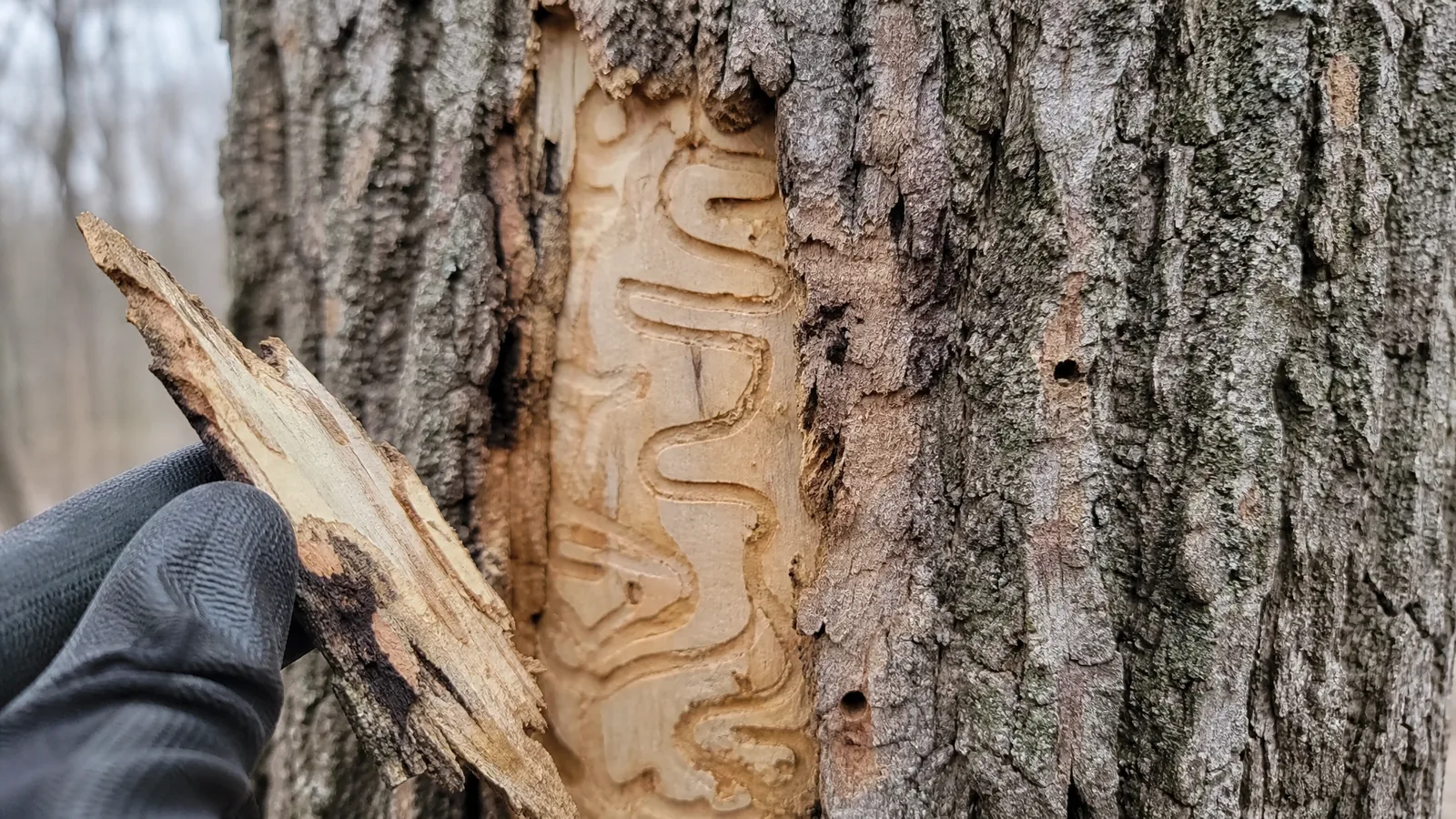
Emerald ash borer reached Michigan in 2002 and it is the reason so much standing dead wood in Kent County yards is ash. The larvae feed in the cambium and girdle the tree from the inside, so the symptoms run top-down: thinning upper canopy, then sprouts low on the trunk as the tree tries to route around the damage, then woodpecker flecking, then D-shaped exit holes about an eighth of an inch across.
Treatment is a trunk injection, usually emamectin benzoate, which is genuinely effective and lasts two years per application. The threshold is canopy: below about thirty to forty percent crown loss, treatment is worth doing and cheaper than removal for a long time. Above it, you are slowing a decline rather than stopping it, and the money is better spent on removal before the wood goes brittle. The City of Grand Rapids has treated more than 1,400 of its own ash trees on exactly this logic, but that programme covers street and park trees, not yours.
Do not move ash firewood. That is how it travelled in the first place.
The rest of the list, briefly
Apple scab on crabapples, everywhere in this town, ugly and almost never fatal. Anthracnose on sycamore and ash in a wet spring, same story. Dutch elm disease still runs through the surviving large elms. Verticillium wilt turns up in maples and is not treatable, only managed. Spongy moth runs in cycles and defoliates oaks in outbreak years without usually killing a healthy tree. Hemlock woolly adelgid is the newer one, mostly a lakeshore problem so far, and the City's forestry programme is watching for it alongside emerald ash borer and spongy moth.
The unglamorous truth is that most tree decline we get called to is not a pest at all. It is girdling roots, a mulch volcano piled against the trunk, soil compaction, or a root flare buried six inches under fill from a landscaping job. Those are free to diagnose and cheap to fix, and no chemical helps any of them.
What tree disease treatment costs in Grand Rapids
| Problem | Treatment | Typical cost | Cost if you wait and remove instead |
|---|---|---|---|
| Emerald ash borer, healthy canopy | Trunk injection, every 2 years | $8 to $15 per inch DBH | $1,000 to $2,500, more once brittle |
| Emerald ash borer, over 40% crown loss | Not recommended | n/a | $1,500 to $4,000, often a lift job |
| Oak wilt, healthy oaks near an infection | Propiconazole injection | $12 to $22 per inch DBH | $2,500 to $4,000 per mature oak |
| Oak wilt, infected red oak | Removal, plus root graft barrier | Trenching from $900 | Spreads to the neighbours' oaks too |
| Girdling roots or buried root flare | Root collar excavation | $250 to $600 | Decline over 5 to 15 years |
| Apple scab, anthracnose | Usually nothing. Rake and improve airflow | $0 to $250 | Cosmetic, rarely fatal |
DBH means trunk diameter at four and a half feet from the ground. A twenty-inch ash therefore costs roughly $160 to $300 to treat, every two years, against $1,000 to $2,500 to remove. The arithmetic only works while the canopy is still there, which is why the diagnosis visit matters more than the price of the injection.
Get a written price for tree disease treatment
Free estimate, walked by an arborist, with the stump and the brush already on the sheet.
Free written estimate Insured, COI on request We haul it or we leave the chips
Common questions about tree disease treatment in Grand Rapids
- When is it too late to treat an ash tree?
Past roughly thirty to forty percent canopy loss, treatment stops being worth the money. The injection protects the cambium the tree still has, and it cannot rebuild what the larvae have already girdled. A tree that has lost half its crown and is sprouting from the trunk is telling you it has already spent its reserves. At that point the sensible spend is removal while a climber can still work the tree, because dead ash goes brittle fast and the job gets a thousand dollars more expensive.
- How do I know if my oak has oak wilt?
The classic sign is a red oak dropping green or half-brown leaves in June, July or August, starting at the top and working down, with the whole crown gone inside a few weeks. Leaves often brown from the tip and outer edge inward with a sharp line between green and brown. Autumn leaf drop is not it, and neither is a slow thinning over several years, which is usually root or soil trouble. If you have red oaks and one is dropping green leaves in July, call somebody that week, because the root grafts mean your neighbours' oaks are already exposed.
- Can I prune an oak in the summer if I'm careful?
Not if you have a choice. The Michigan DNR asks for no oak pruning between April 15 and July 15 and the City of Grand Rapids asks for none between April and September, and 'careful' does not change the beetle's behaviour. If a storm has left a genuinely hazardous oak limb inside the window, we will do the minimum needed to make it safe and paint every cut the same day, then come back in winter for the rest of the work.
- Does the City treat ash trees on my street?
The Grand Rapids Forestry Division has treated more than 1,400 City ash trees against emerald ash borer, and those are street and park trees rather than trees on private property. If the ash you are worried about is in the right-of-way strip between your sidewalk and the road, it is a City tree and the number is 311. If it is inside your property line, it is yours to treat or remove.
Where we do tree disease treatment
Every community below has its own page with that town's own rules and prices on it.
- Tree Disease Treatment in Wyoming
- Tree Disease Treatment in Kentwood
- Tree Disease Treatment in Grandville
- Tree Disease Treatment in Walker
- Tree Disease Treatment in East Grand Rapids
- Tree Disease Treatment in Comstock Park
- Tree Disease Treatment in Jenison
- Tree Disease Treatment in Byron Center
- Tree Disease Treatment in Cascade
- Tree Disease Treatment in Ada
- Tree Disease Treatment in Hudsonville
- Tree Disease Treatment in Rockford
Related services
Ask about tree disease treatment
A person calls you back the same day, or first thing the next morning if you reach us after six. Storm calls get picked up whenever they come in.
Prefer to talk? Ring (616) 297-2972. Photographs help more than descriptions, and one that shows the gate or the side of the house is worth three of the tree.